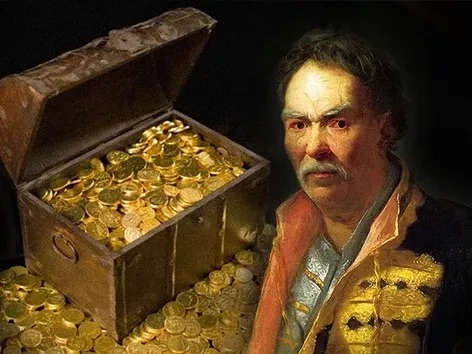
The story of the gold allegedly left behind by Ukrainian Hetman Pavlo Polubotok has been a source of controversy and interest for researchers, politicians, and ordinary citizens for over 300 years. In 1723, anticipating his arrest, Polubotok allegedly deposited 200,000 gold coins in an English bank at 7.5% per annum. In his will, he stated that 80% of these funds should be used to ensure Ukraine’s independence. This story, full of mysteries and contradictions, is becoming more and more resonant every year.
Who is Pavlo Polubotok?
Pavlo Leontiyovych Polubotok was one of the most famous hetmans of Ukraine in the seventeenth and eighteenth centuries. The son of a Pereyaslav colonel, he was an educated and ambitious man who was able to rise to the highest heights of Ukrainian and Russian politics at the time. Polubotok became famous not only for his diplomatic and political maneuvers but also for his incredible fortune, which included not only gold but also various cultural relics such as jewelry, icons, weapons, and tableware.
Despite his successes, at some point Polubotok came into conflict with Hetman Ivan Mazepa and was forced to support Peter the Great. However, in the future, his actions were aimed at preserving Ukraine’s autonomy within Russia. Sensing that his days as hetman were coming to an end, Polubotok transferred his treasures to England, leaving a will stating that they should be used for the benefit of an independent Ukraine.
The legend of Polubotok’s gold
The legend of Polubotko’s gold became known after its publication in 1907, when Russian professor Alexander Rubets mentioned the hetman’s contributions in his journal. After that, the story gained popularity, becoming the subject of numerous studies and rumors. According to this story, when the hetman was arrested in St. Petersburg in 1724, he already knew that he might not return. All of his wealth, including gold coins, was allegedly transferred to England, where it was to wait for the time when Ukraine would become independent again.
According to the will, only a direct descendant of Polubotko who could document his origins could have access to these funds. However, as it turned out, it was extremely difficult to find such descendants.
Is it possible to return the gold?
Despite the lack of direct evidence of the existence of this deposit, various requests were repeatedly made to the British authorities both during the Soviet and post-Soviet periods. In 1922, a man who called himself Ostap Polubotko and claimed to be a direct descendant of the Hetman approached the Ukrainian SSR embassy in Vienna. He showed copies of documents confirming the deposit and offered to conclude an agreement with the Ukrainian government. However, attempts to reach an agreement with the Bank of England were unsuccessful.
Since then, the question of the fate of Polubotko’s gold has remained at the level of rumors and speculation. Even during the years of Ukraine’s independence and during the presidency of Leonid Kravchuk, no official confirmation of the deposit’s existence was received.
New mysteries and discoveries
In 2014, the Polish newspaper Kurier Poranny reported an amazing discovery made in London, in the prestigious West End. During construction work, four barrels of gold coins were discovered, allegedly left by Polubotok. The examination showed that most of the coins were covered with rhodium, a metal six times more expensive than gold, which, as it turned out, was mined in the Carpathians, near Mount Hoverla.
However, despite this sensational discovery, no new confirmation or details of this investigation have been published in public sources. There are even theories that the coins had an impact on the political processes in the UK, including the country’s withdrawal from the European Union. It seemed that the story was forgotten, but an unknown business investigator appeared.
However, in 2019, a new, unexpected chapter in this story emerged, drawing attention to this legend once again. Mike de Peyrac, traveling by train from Kyiv to Ivano-Frankivsk, met a sociable woman named Lesia in his suite. It turned out that she, a self-sufficient businesswoman with her own publishing house, was conducting her own investigation into the Polubotko treasure.
With the words «not fiction, but reality,» she said that she had been working for several years to collect documents confirming the existence of this treasure. Her investigation took on a serious scale, and as a result, she obtained all the necessary documents confirming the existence of the deposit and its intended purpose. It is known that Lesia did not stop there. She made a copy of the documents and sent them to the President of Ukraine Petro Poroshenko.
The mysterious intervention of the SBU
As is typical in the world of high politics and business, things took a more complicated and tense turn. After Lesya Grigoryevna handed over copies of the documents, it became obvious that not everyone was ready to publicly acknowledge this fact. According to sources, Poroshenko had long been informed of the story, as it was under the control not only of him but also of the highest government circles in Britain.
The actions of the Security Service of Ukraine (SBU) were not long in coming. Shortly after the documents were handed over, Lesya’s office in Ivano-Frankivsk was searched and all documents and computer equipment were seized. But, as it turned out later, the key documents were not in Lesia’s office or at home — they were hidden in a safe place, away from prying eyes. The SBU conducted an unsuccessful search, never finding what they were looking for.
Where does this trail lead?
At that time, Lesia Hryhorievna was already in France, and the story itself was still going strong. Behind the scenes, a powerful struggle for the return of Polubotko’s treasure was still going on. The documents confirming the existence of the treasure remain, and the people who financed this investigation do not give up.
Up to this point, one can only guess whether there is a real chance of recovering the gold or whether this is just a continuation of a legend that may remain a myth. But is it possible to believe that Polubotko’s true descendants, or those who are ready to defend these rights, will get their part of history?
This question has no answers, but one thing is clear: the story of Pavlo Polubotko still has the power to stir minds and arouse great interest in the hearts of those who want to uncover the greatest secrets of Ukrainian history. And while the world waits, Lesia and her associates continue their search, preparing a strategy for the return of this incredible treasure, which can become not just a true national heritage, but give Ukrainians a quick victory with a first-class state, in demand in the world, from high-quality and rare wine to rare expensive metals and stones.